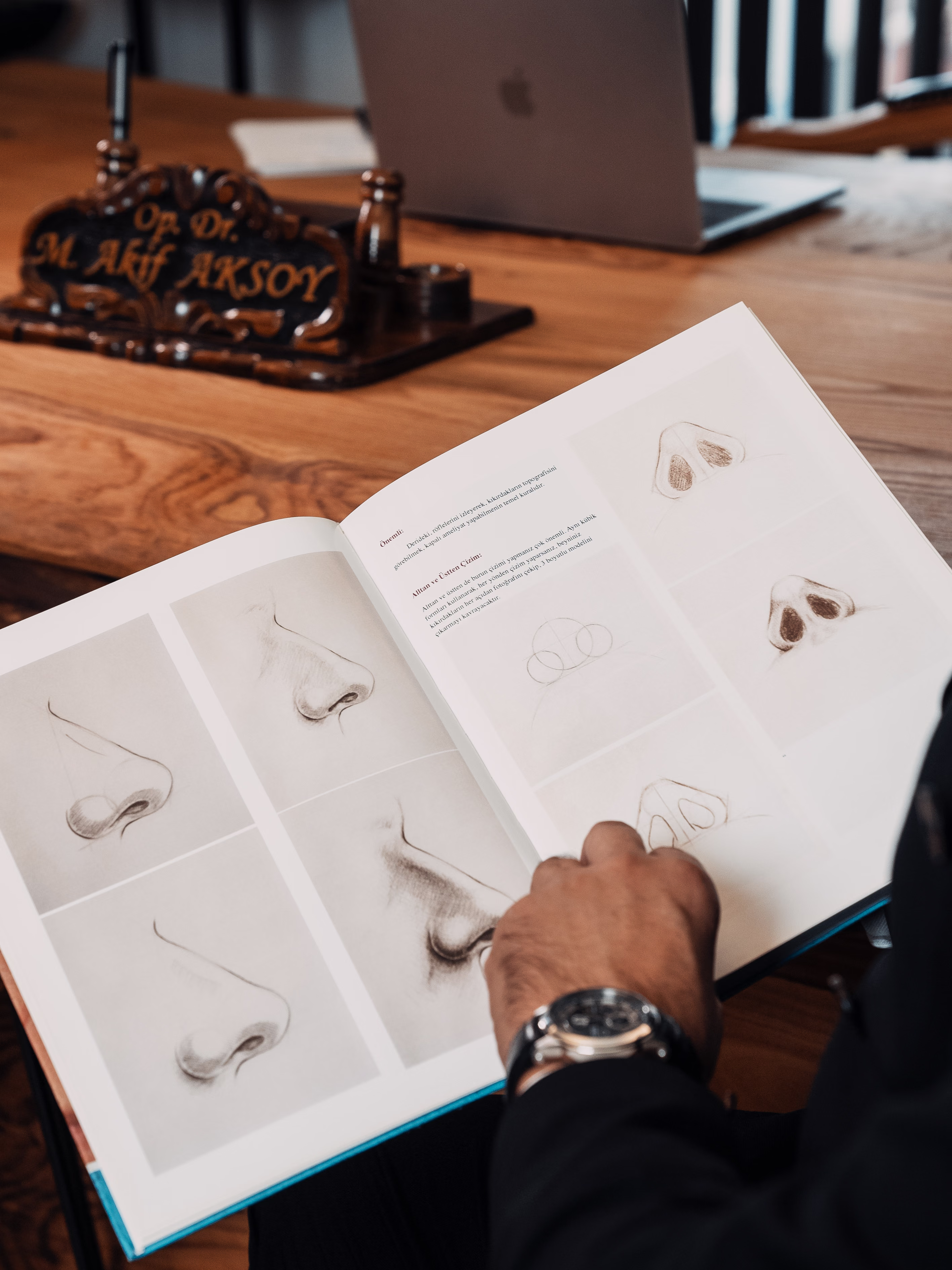

Because it sits at the centre of the face and governs how symmetry is perceived, even millimetric changes to the nose are noticed. It is also the first stage of the airway: it warms, humidifies and filters the air we breathe.
Rhinoplasty concerns both of these functions at once. A good outcome is measured not only by how well the nose suits the face, but also by how comfortably the patient breathes afterwards. This page explains how the operation is planned, which techniques are used, and how healing progresses.
What is rhinoplasty?
Rhinoplasty is the surgical reshaping of the bony framework, cartilage structure and soft tissues of the nose. The aim may be purely a change in appearance, the correction of a breathing problem, or both.
The rhinoplasty guideline of the American Academy of Otolaryngology–Head and Neck Surgery (AAO-HNS) recommends that the patient's expectations and nasal breathing be assessed separately before surgery. In other words, "cosmetic" and "functional" rhinoplasty are not sharply separable in practice.
| Term | What it means |
|---|---|
| Rhinoplasty | Surgical reshaping of the nose |
| Septoplasty | Straightening of the deviated partition inside the nose |
| Septorhinoplasty | Reshaping and septal correction in the same session |
| Revision rhinoplasty | A second operation on a nose that has been operated on before |
| Turbinate reduction | Reducing the internal nasal tissue to widen the airway |
Who is it suitable for?
Rhinoplasty starts from the person's own wish; it is not a decision taken on someone else's behalf. Suitability is assessed on the following:
- Completed facial growth. A lower limit of around 17 for women and 18 for men is generally accepted.
- Realistic expectations. Surgery improves how the nose harmonises with the face; it does not promise a different face.
- General health. Uncontrolled hypertension, bleeding disorders or active infection may mean postponing the procedure.
- Smoking and alcohol use that can be adjusted.
Where the picture suggests body dysmorphic disorder, surgery alone is not the answer; psychiatric assessment is recommended first.
How do you prepare?
At the first consultation the nose is examined both externally and internally, with an endoscope. If there is a breathing complaint, the septum, turbinates and nasal valve are each assessed separately. Photography is the basis of both planning and later comparison.
The usual sequence before surgery:
- Examination and photography — facial proportions, skin thickness and the internal structures
- Discussing the plan — which changes are possible and which are not
- Blood tests and anaesthetic assessment
- Medication review — blood thinners and herbal supplements stopped with medical approval
- Stopping smoking — ideally at least 2–4 weeks before surgery
How is the operation performed?
Rhinoplasty is carried out under general anaesthesia and takes 2–3 hours on average. The duration depends on whether the septum is treated, whether grafts are used, and whether the patient has had previous surgery.
There are two basic approaches, according to where the surgeon makes the incisions:
| Closed (endonasal) technique | Open (external) technique | |
|---|---|---|
| Incisions | Inside the nose only | Inside the nose + a small columellar incision |
| External scar | None | A fine line that fades over time |
| Field of view | Limited | Direct and wide |
| Often chosen for | Measured changes, mainly to the dorsum | Detailed tip work, asymmetric or revision cases |
A recent systematic review comparing open and closed techniques reports that the two produce broadly similar results in terms of patient satisfaction, and that the choice should follow the structure of the nose and the extent of the work planned. You will find the details on the closed technique and open technique pages.
Two routes to lowering the dorsal hump
There are two basic approaches to reducing a hump on the nasal dorsum:
- Classic (structural) method: the hump is reduced and the resulting open roof is closed, rebuilding the dorsum.
- Preservation method: the natural dorsal line is kept intact and lowered through work carried out underneath it.
Published meta-analyses show that both can give satisfactory results; which is appropriate depends on the bone and cartilage structure of the nose and on skin thickness.
How does recovery progress?
Healing is gradual. The table below shows a typical course; it varies between individuals.
| Period | What to expect |
|---|---|
| First 48 hours | Blockage, light oozing, swelling and bruising starting around the eyes |
| Days 3–5 | Bruising at its most visible, then beginning to fade |
| Days 6–7 | Splint and sutures removed; first impression |
| Week 2 | Bruising largely gone, return to social life |
| Month 1 | Marked reduction in swelling |
| Months 3–6 | The dorsum and profile line settle |
| Months 6–12 | Refinement of the tip completes |
Points to observe during recovery:
- Sleeping with the head elevated in the first days reduces swelling.
- Heavy exercise, weight training and bending work are postponed for the first 3–4 weeks.
- If bone work was done, spectacle wear is adjusted so that no weight rests on the dorsum for the period your surgeon specifies.
- Sun protection matters for scarring and pigment changes.
- Nasal cleaning and moisturising reduce crusting and speed healing.
What are the risks and possible complications?
In experienced hands rhinoplasty has a well-documented safety profile, but like any operation it carries risk. A systematic review of the frequency of postoperative adverse events reports that serious complications are uncommon.
Possible events include:
- Bleeding and bruising
- Infection
- Temporary altered sensation or numbness at the tip
- Swelling lasting longer than expected
- Persistent or newly arising difficulty breathing
- Asymmetric healing
- Dissatisfaction with the result and the need for a second procedure
Reported revision rates vary between studies and patient groups, but in a proportion of operated patients a second correction may come up for discussion. This possibility is talked through before surgery. For details, see the revision rhinoplasty page.
The list of risks on this page is not exhaustive. Risks specific to you are discussed separately during examination and the informed consent process.
How predictable are the results?
There are variables the surgeon controls and variables the surgeon does not:
| Determined by the surgeon | Determined by the individual |
|---|---|
| Shaping of bone and cartilage | Skin thickness and fatty tissue |
| Placement of supporting grafts | Wound healing pattern, tendency to scar |
| Symmetry achieved surgically | How quickly swelling resolves |
| Widening of the airway | Genetic tissue characteristics |
For this reason no surgeon can guarantee a result. A systematic review of long-term quality of life after septorhinoplasty reports meaningful improvement in both aesthetic and breathing measures — but that does not mean individual outcomes will be alike.
Choosing the right approach for your nose
The following pages address different aspects of the same operation:
| Page | The question it answers |
|---|---|
| Natural rhinoplasty | How is the wish for an "undetectable" result approached? |
| Closed rhinoplasty | How much change is possible without an external incision? |
| Open rhinoplasty | Why might detailed work at the tip be necessary? |
| Male rhinoplasty | Which proportions are preserved in a male face? |
| Revision rhinoplasty | Why is a second operation different? |
| Septoplasty | What is done when a deviation is the cause of obstruction? |